
Marble Armor vs. Traditional Stone Sealant: The Best Protection for Bay Area Homes
- Scott Thomas

- Dec 26, 2025
- 9 min read
The Reality of Maintaining Natural Stone in the Bay Area
You likely spent months selecting the perfect slab for your kitchen island. The veining was perfect. The honed finish felt soft to the touch. It tied the entire room together. Then life happened. You hosted friends for a wine tasting. You sliced a lemon for a cocktail. Someone set down a glass of vinegar-based salad dressing.
The next morning you saw it. A dull, whitish spot glared back at you from your pristine countertop. You scrubbed it, but the spot remained. This is not a stain. It is an etch mark. It is a physical burn on the surface of the stone.
Homeowners in San Jose and the Peninsula face this reality every day. We love our open-concept kitchens and our indoor-outdoor entertaining lifestyle. We do not want to police our guests or hover over our countertops with a coaster in hand.
The industry offers two primary solutions to this problem. The first is the traditional impregnating sealer. The second is a permanent topical coating like Marble Armor. Most homeowners assume a sealer protects them from everything. This assumption leads to disappointment and expensive restoration bills.
To make an informed decision between Marble Armor vs. Traditional Stone Sealant, you must understand the chemistry behind these products. Olson Marble & Stone Care specializes in both technologies. We want you to choose the solution that fits your lifestyle.
Why Marble Etches: The Science of Acid Damage
Marble, travertine, limestone, and onyx share a common chemical composition. They are calcium carbonate stones. This mineral composition gives them their distinct beauty. It also creates a specific vulnerability.
Calcium carbonate reacts instantly when it contacts acid. Common household items are highly acidic. Lemon juice, vinegar, wine, tomato sauce, and even some sodas contain acid. When these liquids touch your stone, a chemical reaction occurs immediately. The acid dissolves a microscopic layer of the stone’s surface. This creates a rough texture that scatters light differently than the surrounding polished or honed area. To your eye, this looks like a dull spot or a water ring.
According to the Natural Stone Institute, this reaction is instantaneous. It happens in seconds. Many homeowners confuse etching with staining. Understanding the difference is critical for protecting your investment.
Why "Stain Proof" Does Not Mean "Etch Proof"
A stain happens when a liquid absorbs into the pores of the stone and leaves a pigment behind. Red wine absorbing into the stone creates a red stain. Oil absorbing into granite creates a dark shadow.
Etching is surface damage. A clear liquid like Sprite or white vinegar leaves no color behind, but it will still leave a permanent etch mark. A stone surface generally needs protection from both threats. However, most products on the market only address one of them.
The Mohs Hardness Scale and Scratch Susceptibility
Chemical damage is not the only threat. Physical damage also dulls your countertops. Geologists use the Mohs Hardness Scale to rank minerals from 1 (softest) to 10 (hardest). Diamond is a 10. Granite is usually a 6 or 7.
Marble ranks between 3 and 4 on this scale. It is relatively soft. Metal pots, pans, and even sliding a rough ceramic bowl across the island scratches the surface. Over time, these micro-scratches accumulate. They create a worn, tired appearance commonly seen in high-traffic kitchens. Liquid sealants provide absolutely no protection against physical scratching.
Marble Armor vs. Traditional Stone Sealant, Traditional Impregnating Sealers: What They Do (and Don’t) Do
The most common product sold with natural stone countertops is an impregnating sealer. Applicators apply this liquid to the stone during installation. The stone absorbs the liquid into its pores. The carrier solvent evaporates, leaving behind protective resin molecules.
These sealers are hydrophobic (water-repelling) and oleophobic (oil-repelling). They reduce the absorbency of the stone. If you spill red wine on a sealed marble surface, the sealer prevents the wine from soaking deep into the pores. It keeps the liquid on the surface longer. This gives you time to wipe it up before it leaves a red stain.
However, the sealer lives below the surface of the stone. It occupies the pores. It does not sit on top like a shell. Because the stone surface remains exposed, acid still touches the calcium carbonate directly. The acid burns the stone before the sealer does any work.
The Maintenance Cycle of Sealants
Impregnating sealers are not permanent. UV light, harsh cleaning products, and general wear break them down. In a busy kitchen, a high-quality sealer degrades within 6 to 12 months.
Homeowners often fail to reseal their countertops frequently enough. This leads to staining issues on top of etching issues. Even with perfect maintenance, you will still see etch marks. You might have a stain-free counter, but it will be covered in dull spots and rings. Fixing these spots requires professional natural stone restoration services. We must grind down the stone to remove the damaged layer and then polish it back to a shine.
When Traditional Sealing Is Sufficient
We do not discourage sealers entirely. They serve a purpose. If you have a low-traffic guest bathroom vanity, a sealer works well. Vertical surfaces like shower walls or backsplashes rarely see acidic food contact or heavy wear. In these areas, the risk of etching is low.
Darker granites and quartzites are also less prone to etching than marble. For these harder, less reactive stones, a high-quality impregnating sealer provides adequate protection. But for a marble kitchen island in a busy home, sealing alone is rarely enough to keep the stone looking new.
Marble Armor: The Permanent Anti-Etch Solution
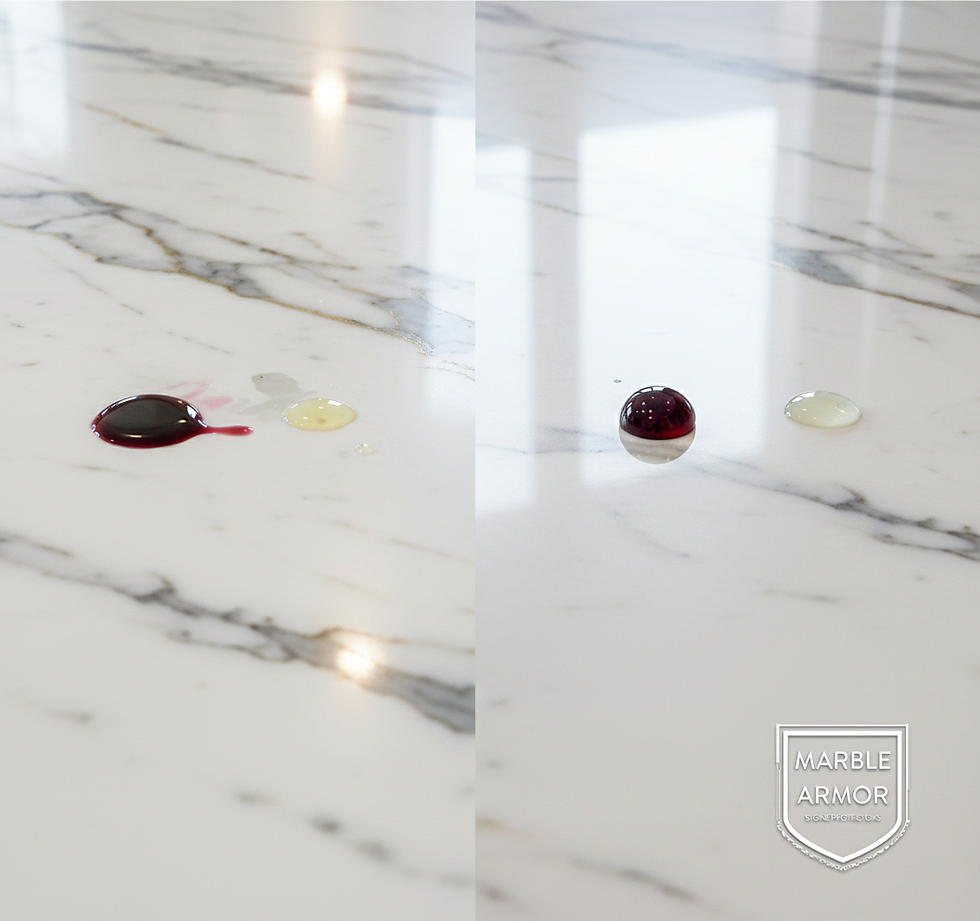
If you want the look of marble without the maintenance of marble, you need a barrier. This is where advanced coatings like Marble Armor come in. Unlike a sealer that penetrates the stone, Marble Armor acts as a shield. It is a clear, durable film applied directly over the surface.
Think of it like a screen protector for your smartphone. If you drop your keys on your phone, the screen protector takes the scratch. The glass underneath remains perfect. Marble Armor functions the same way for your countertops. It acts as a sacrificial layer.
How UV-Cured Coatings Stop Acid Attacks
The primary benefit of Marble Armor is acid immunity. The film is chemically inert. You could squeeze a lemon onto the surface and leave it there for hours. You could spill vinegar and let it dry. The acid never touches the stone. It sits harmlessly on the plastic polymer surface.
This technology solves the problem that sealers ignore. It eliminates the chemical reaction that causes etching. For homeowners who love to cook and entertain, this changes the experience of owning marble. You stop worrying about every spill.
Our team specializes in the precise Marble Armor application process. We prepare the stone, apply the film, and use UV light to cure it instantly. This creates a hard, durable finish that is ready for use immediately.
Heat Resistance and Aesthetic Options
Early versions of stone coatings looked like plastic wrap. They yellowed over time and peeled easily. Technology has improved significantly. Modern Marble Armor is ultra-thin and clear. It does not look like a thick plastic sheet.
You also have options for the finish. If you have honed marble, we apply a matte version. If you have polished marble, we apply a high-gloss version. The coating merges with the visual texture of the stone.
Heat resistance is another common concern. Marble Armor withstands heat up to roughly 400 degrees Fahrenheit. While we always recommend using a trivet or hot pad for safety, the coating handles typical kitchen temperatures better than older laminates.
Head-to-Head Comparison: Sealer vs. Coating
Let us compare these two options directly, Marble Armor vs. Traditional Stone Sealants. You need to weigh the level of protection against your expectations for the stone.
Protection Levels
Sealers protect against absorption. They stop red wine from turning your white marble pink. They do not stop vinegar from turning your polished marble dull. They offer zero protection against scratches from pots and pans.
Marble Armor protects against everything. It stops stains because it is non-porous. It stops etching because it is acid-resistant. It stops scratches because it is harder than the stone surface itself. If you drag a heavy pot across the counter, the coating might scratch, but the stone underneath remains safe.
Longevity and Warranty
A sealer requires re-application every year. It is a maintenance product. It does not come with a long-term performance guarantee against damage. If your stone etches, the manufacturer of the sealer is not liable.
Advanced coatings are different. They are engineered for durability. Industry data and technical specifications from material scientists indicate that UV-cured acrylics and polyurethanes maintain their integrity for years. Marble Armor typically carries a 10-year warranty against etching and staining. This offers peace of mind that a bottle of liquid sealer cannot match. See standards from organizations like ASTM International for details on how protective films are tested for abrasion and chemical resistance.
Cost-Benefit Analysis: Is the Upfront Cost Worth It?
We must address the cost. Installing Marble Armor is significantly more expensive than applying a sealer. A sealer costs a few hundred dollars or comes included with your fabrication. Marble Armor is a technical installation that costs more.
However, you must look at the total cost of ownership over ten years.
The Hidden Costs of Restoration
If you stick with a sealer, you will get etch marks. To fix them, you must hire a restoration company. We come in, mask off your kitchen, wet grind the stone, hone it, polish it, and reseal it. This process costs a significant amount of money.
In a busy kitchen, you might need restoration every two to three years to keep the stone looking good. Over a decade, you might pay for three or four full restorations. Those costs add up.
Compare that to the one-time cost of Marble Armor. You pay once for the installation. You eliminate the need for restoration grinding. You eliminate the need for annual resealing.
Increasing Home Value in San Jose
Your countertops are a fixed asset in your home. When you eventually sell your property, the condition of the kitchen drives the price. A kitchen with stained, etched, and dull marble looks tired. It tells potential buyers that the home needs work.
A kitchen with pristine marble surfaces commands a premium. The coating preserves the factory finish of the stone indefinitely. It protects your equity.
Beyond Marble: Protecting Other Surfaces
While marble gets the most attention, other surfaces in your home require similar care. Limestone and travertine are equally soft and reactive. High-end concrete counters also suffer from staining and etching if not properly treated.
At Olson Marble & Stone Care, we look at the whole picture. We apply our knowledge of stone protection to other areas, including concrete services including resurfacing and polishing. The principles remain the same. Porous surfaces need a barrier to survive daily life in a modern home.
Frequently Asked Questions About Stone Protection
Does sealing marble prevent etching?
No. Traditional impregnating sealers only prevent stains from absorbing into the pores. They do not stop acid from burning the surface of the stone.
Can you put hot pans on Marble Armor?
Marble Armor is heat resistant, but we always recommend using a trivet. Avoiding direct contact with extremely hot cookware preserves the life of the coating.
How long does Marble Armor last?
With proper care, the application lasts up to 10 years. This is significantly longer than the 6 to 12-month effective life of a standard liquid sealer.
Does the coating look like plastic?
No. The film is incredibly thin and clear. We offer it in honed or polished finishes to match the natural look of your stone perfectly.
Is it expensive to remove if I change my mind?
Removal is a straightforward professional process. We can remove the film without damaging the stone, returning the surface to its original state.
Make the Right Choice for Your Stone with Olson Marble & Stone Care

You have a choice to make. You can accept the patina, the etch marks, and the regular maintenance that comes with traditional sealing. Or, you can choose a permanent solution that keeps your kitchen looking brand new.
If you want to host your next dinner party without worrying about where your guests set their wine glasses, Marble Armor is the answer. It is the only way to guarantee your stone stays perfect in a real-world environment.
For more insights on luxury home materials, reputable design resources like Architectural Digest frequently discuss the pros and cons of natural materials in modern kitchens.
We are ready to help you protect your investment. Contact Olson Marble & Stone Care today to schedule a consultation and get a quote for your project.


Comments