
Why Does My Marble Shower Floor Stay Dark After It Dries?


A marble shower floor discoloration problem can be confusing because the stone may feel dry while darker areas remain visible. Marble naturally changes tone when it absorbs water, especially light stones such as Carrara. The concern begins when the same dark patches stay for long periods, return around the same tiles, or concentrate near the drain.
The cause is not always dirt or a failed sealer. Moisture can remain in the marble, setting material, mortar bed, or shower assembly after the exposed surface feels dry. Staining, mineral deposits, oxidation, and etching can also change the appearance.
For San Jose and Greater Bay Area homeowners, Olson Marble & Stone Care starts with diagnosis. The goal is to identify whether the problem is at the stone surface or below it before you pay for cleaning, honing, polishing, sealing, or demolition.
Why Marble Can Look Dark Even When the Surface Feels Dry
Marble has interconnected pores and capillaries. Water can move into those spaces and change how light passes through the stone. Light marble makes this tonal shift easier to see. A shower floor can look gray, blotchy, or darker after use and then return toward its normal color as moisture leaves.
Normal temporary darkening is different from persistent discoloration. If the same area stays dark after the shower has been unused, repeatedly forms a ring near the drain, or remains darker than surrounding tiles, you need more than a surface wipe-down. The visible face may be dry while moisture remains deeper in the stone or materials below it.
Do not judge the problem by one drying-time rule. Drying depends on stone density, tile thickness, mortar coverage, airflow, ventilation, waterproofing method, and shower frequency. The pattern is usually more useful than the clock.
The Natural Stone Institute separates staining, etching, mineral deposits, and cleaning chemistry because these conditions require different responses. An experienced technician does the same.
Normal Absorption Versus Persistent Moisture
Broad darkening that fades between showers may reflect ordinary absorption. One group of tiles that remains dark, or the same shape that returns every day, deserves closer evaluation.
Why Light Marble Shows the Change So Clearly
Carrara, Calacatta, and other light marbles make moisture changes easy to see.
The Pattern of Darkening Can Point Toward the Cause
A restoration professional does not see one generic problem called a dark marble floor. The location, shape, texture, and timing help separate several possible causes.
A recurring dark halo around a traditional drain can justify investigation of drainage conditions and weep pathways. Darkened tile edges can resemble picture framing, where absorptive stone pulls moisture or installation liquids at the perimeter. Random dark patches can correspond with uneven moisture distribution, low areas, or inconsistent mortar contact beneath individual pieces. LATICRETE specifically warns that some absorptive white marbles can develop darkened edges known as picture framing.
What you see | Possible category | What it may mean |
Floor darkens after use, then recovers | Temporary absorption | Moisture entered the marble and later evaporated |
Same dark area repeatedly returns | Persistent moisture | Investigate what is holding water there |
White or cloudy film | Hard-water residue | Minerals may be sitting on the surface |
White crystalline deposit | Efflorescence | Moisture may be transporting soluble salts |
Brown or orange mark | Oxidation or staining | Iron-bearing material may be reacting with moisture |
Dull or rough area | Etching | The marble surface has been chemically altered |
Etching deserves special attention. Marble contains calcium carbonate. Acidic cleaners can react with it and alter the finish. Once etched, more cleaning will not restore the missing clarity. The Natural Stone Institute warns acidic products such as vinegar and lemon can dull or etch calcareous stone.
The Problem May Be Under the Marble, Not On It
Your marble is only the visible finish of a wet-area assembly. Below it may be thinset, a mortar bed, waterproofing, a shower pan, and drain components designed to move water toward the drain. If those parts do not manage moisture correctly, cleaning the marble cannot solve the source.
Traditional shower assemblies may use drainage paths and weep holes to let water reaching the mortar bed move toward the drain. Bonded waterproofing systems manage water differently. Low spots, blocked drainage paths, incomplete mortar coverage, damaged joints, or a faulty waterproofing assembly can all affect how long moisture remains beneath stone.
This is why grout sealer is not a waterproofing repair. The Tile Council of North America states grout joints are not waterproof and wet areas must rely on the installation method and substrate for water protection.
Olson's natural stone restoration service can address stone-surface conditions such as etching, wear, staining, mineral buildup, and finish loss. It cannot make a failed shower pan or defective waterproofing assembly sound by polishing marble.
Why More Sealer May Not Stop the Darkening
An impregnating sealer can reduce absorption of certain staining agents. It is not a waterproof membrane. Adding another coat before the moisture source is understood can waste money.
The same distinction applies to AntiEtch Marble Protection. Its role is surface protection against etching and staining, not repair of retained water beneath a shower floor.
San Jose Hard Water Can Make the Diagnosis More Confusing
Hard water matters in marble showers, but it must be blamed for the right symptom. Mineral-rich water can leave calcium and other dissolved solids on the surface as water evaporates. Those deposits may create white haze, cloudy film, crust around fixtures, or buildup along grout lines. They are different from internal-looking dark areas caused by absorbed or retained moisture.
San Jose Water's 2025 report shows why local conditions vary. Hardness averaged 151 ppm for mountain surface water, 288 ppm for groundwater, and 99 ppm for Valley Water surface water. The reported groundwater range was 175 to 451 ppm. Homes in San Jose, Los Gatos, Saratoga, and nearby communities can therefore experience different mineral buildup depending on water source.
The mistake is attacking every white deposit with an acidic descaler. Marble is calcium-carbonate stone. Acid can dissolve mineral scale while also attacking the marble below it. You may remove the crust and expose a dull or rough etched surface.
Material identification matters. Moisture behavior in marble is not diagnosed the same way as a coating problem on concrete surfaces or an appearance issue involving quartz and engineered stone. A professional should identify the material and failure mechanism before choosing chemistry or abrasives.
Can the Marble Be Restored, or Does the Shower Need Repair?
If the problem is limited to the stone surface, restoration may preserve the existing marble and avoid unnecessary demolition. If the moisture source is below the stone, cosmetic work alone is the wrong first move.
Professional cleaning can remove soil, soap residue, and compatible mineral buildup. A poultice may help with certain absorbed stains after the stain type is identified. Etching and finish loss require mechanical refinement, not another cleaner. Honing uses controlled diamond abrasion to remove damaged surface material and establish an even finish. A technician works through progressively finer abrasives, stopping at the required honed finish or refining farther before polishing. The starting grit and progression depend on damage depth, lippage, stone response, and the finish being matched.
Polishing is not cleaning. It refines a properly honed surface to restore clarity and reflectivity. Sealing follows only when appropriate. It does not repair etching or correct a wet mortar bed.
This is where professional judgment protects your money. If the marble can be restored, you may avoid tear-out, disposal, replacement matching, and reconstruction. If the drain, slope, waterproofing, or shower assembly is defective, polishing first can produce a floor that looks better but darkens again.
A reputable restoration company should tell you when the correct next step is not more restoration.
What DIY Treatment Often Misses
Repeated cycles of stronger cleaner, more scrubbing, sealer, and polishing products can add new damage. Acid can etch. Abrasive pads can alter the finish. Sealer can change absorption behavior. Once several treatments overlap, diagnosis becomes harder.
What to Do Before You Pay for the Wrong Fix
If the same dark marble keeps returning, stop treating its appearance as proof of one specific cause. Give the shower time to dry as much as practical, avoid new cleaners or sealers, and document what changes.
Before requesting an inspection, prepare five pieces of information:
Take one photo after the shower has been unused and is as dry as practical.
Take another shortly after normal shower use.
Photograph the entire floor with the drain visible.
Take a close-up of the darkest recurring area.
Write down cleaners, acidic descalers, sealers, polishing powders, or other products already used.
Those photos can reveal whether the pattern follows individual tiles, tile edges, the drain, grout joints, or a broader section. Product history can explain etching, haze, sealer behavior, or staining that might otherwise look like moisture.
If safe cleaning and drying do not change the pattern, the next move is diagnosis, not stronger chemistry. Contact Olson Marble & Stone Care to discuss persistent marble shower discoloration in San Jose or the Greater San Francisco Bay Area. The goal is to determine whether you need cleaning, stain treatment, honing, polishing, sealing, or evaluation of the shower assembly before money is spent on the wrong service.
Frequently Asked Questions
Why does marble get darker when it gets wet?
Marble gets darker because water enters pores and capillaries within the stone and changes how light passes through it. Light marble shows this effect more clearly. Temporary darkening can be normal. Persistent or repeatedly patterned darkening deserves closer inspection because moisture may be remaining in the stone or materials beneath it.
Why does my marble shower floor look wet even when it feels dry?
The exposed surface can feel dry while moisture remains deeper in the marble, mortar, or shower assembly. If the same dark areas remain after extended drying or repeatedly return in the same pattern, surface touch alone is not enough to prove the installation beneath the stone has dried.
How long should marble take to dry after a shower?
There is no universal drying time for a marble shower floor. Stone density, thickness, mortar coverage, ventilation, temperature, joint condition, waterproofing method, and shower frequency all affect drying. A repeating dark pattern is usually more useful diagnostically than comparing your shower to a fixed number of hours.
Can sealing marble stop it from absorbing water?
No. A penetrating or impregnating sealer can reduce absorption of certain staining materials, but it does not make a marble shower floor waterproof. It cannot replace proper slope, drainage, waterproofing, or a functioning shower assembly. Sealing should follow diagnosis, not be used as a blind response to persistent darkening.
Can a dark marble shower floor be restored without replacing it?
Yes, when the problem is limited to removable deposits, certain stains, etching, or finish damage. Cleaning, poulticing, honing, or polishing may restore the stone. If persistent darkening comes from defective drainage or waterproofing beneath the marble, the underlying problem must be corrected before cosmetic restoration can provide a lasting result.
Get the Cause Right Before You Restore the Surface
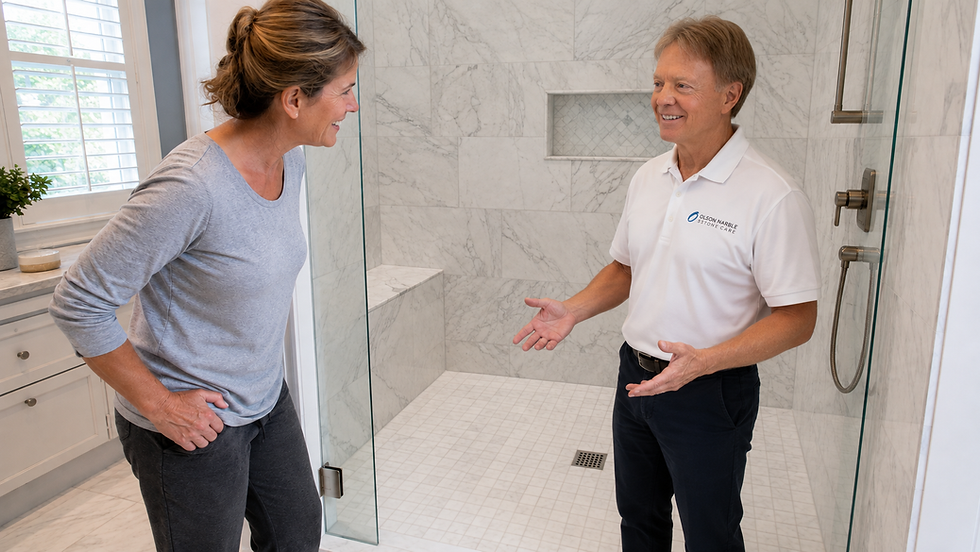
A dark marble shower floor is a symptom, not a diagnosis. The stone may be absorbing water normally, holding moisture longer than expected, carrying a stain, showing mineral deposits, suffering from etching, or revealing a problem deeper in the shower assembly.
The expensive mistake is choosing a treatment before identifying the condition. More sealer will not repair waterproofing. Stronger cleaner will not remove an etch. Polishing will not clear a blocked drainage path. Replacement may be unnecessary when damage is limited to the stone surface.
Olson's value is making that distinction correctly. If your marble shower floor in San Jose, Los Gatos, Saratoga, Palo Alto, or elsewhere in the Greater Bay Area keeps looking dark after it should be dry, schedule an Olson evaluation before applying another product. A proper inspection can also prevent unnecessary surface work when the real correction belongs below the stone. The right diagnosis protects the marble, the shower assembly, and the money you spend fixing it.


