
Can Pet Urine Permanently Damage Marble, Travertine, or Limestone


Yes, pet urine can damage marble, travertine, and limestone. Depending on how long it remains on the surface, the condition of the stone, and where the liquid penetrates, pet urine can leave discoloration, absorbed staining, persistent odor, or damage to the stone's finish.
But "permanent damage" needs some explanation.
A pet accident can permanently alter an existing polished or honed finish so that cleaning alone will not restore it. That does not necessarily mean the stone itself is ruined or needs replacement. Many damaged surfaces can be professionally treated, honed, polished, or otherwise restored.
The first step is figuring out what actually happened. A dark stain, dull patch, and lingering odor may look like one problem, but they can have very different causes and require different solutions.
What Does Pet Urine Actually Do to Natural Stone?
Marble, travertine, and limestone are calcareous stones composed primarily of calcium carbonate. That composition matters because calcium carbonate is sensitive to acidic substances. The Natural Stone Institute recommends mild, non-acidic cleaners for calcareous stone and warns that products containing vinegar, lemon, or other acids can dull or etch these materials. Natural Stone Institute
When a pet urinates on one of these surfaces, several things can happen. The severity depends on the stone, its finish and condition, how quickly the accident is discovered, existing protection, and whether liquid reaches grout, joints, fills, or other materials.
Surface Contamination
If you catch an accident quickly, much of the contamination may still be at or near the surface.
The first response should be simple. Blot the liquid instead of wiping it across a larger area. The Natural Stone Institute recommends blotting spills immediately, then cleaning and rinsing the stone appropriately. Natural Stone Institute
Aggressive scrubbing or grabbing the strongest household cleaner available can turn a manageable problem into stone damage.
Absorbed Staining
Urine can also penetrate below the surface and cause discoloration. The Natural Stone Institute specifically lists urine as an organic staining agent and notes that deep or stubborn stains may require a poultice or professional treatment. Natural Stone Institute
This explains why a floor can be clean to the touch but still show a mark.
A stain and an etch are also not the same thing. A stain involves material penetrating or discoloring the stone. An etch involves a physical change to the surface.
In some situations, both conditions can exist in the same area.
Etching and Finish Damage
Calcite-based marble, travertine, and limestone are susceptible to chemical etching. When the surface has been etched, the problem is no longer something simply sitting on top of the stone.
Arizona Tile describes etching as surface corrosion rather than staining. On polished stone, the affected area may appear lighter, duller, or less reflective than the surrounding surface. Arizona Tile
This distinction is critical because you cannot simply "clean off" missing or altered finish.
Odor Below the Surface
Persistent odor introduces another diagnostic problem.
Liquid may reach the stone itself, grout lines, joints, travertine fills, cracks, or other porous materials associated with the installation. Cleaning the visible stone surface does not prove that all contamination below or around it has been addressed.
A professional evaluation should therefore consider where the odor is coming from, rather than automatically assuming the marble or other stone is the only source.
How Can You Tell Whether You Have a Stain or Permanent Surface Damage?
Start with what you can see, feel, and smell.
What You Notice | What It May Indicate |
Darkened area | Moisture or absorbed contamination |
Yellow or brown discoloration | Possible organic staining |
Dull or lighter patch | Possible etching or finish damage |
Rough or different texture | Surface alteration |
Persistent odor | Contamination may remain below or around the surface |
Problem concentrated around grout | Grout or joint contamination may be involved |
Area remains dull after cleaning | Restoration may be needed rather than more cleaning |
These are clues, not definitive diagnoses.
For example, continuing to scrub a dull spot may accomplish nothing if the problem is an etch. Likewise, polishing an area does not address an absorbed stain that first requires stain treatment.
Why Polished Marble Makes Damage Particularly Noticeable
Polished marble relies on a highly refined surface to create reflection and visual clarity. A relatively small area of surface damage can disrupt that reflection and make the affected spot stand out under overhead lighting or sunlight.
You may notice that the area looks fine from one direction but becomes obvious when light hits it from another angle.
A stone restoration professional can examine the surface under different lighting and determine whether the problem is primarily discoloration, loss of finish, physical damage, or some combination of these conditions.
That diagnosis should come before choosing the restoration method.
Can Pet Urine Damage Sealed Marble, Travertine, or Limestone?
Yes.
One of the biggest misconceptions about natural stone is that "sealed" means liquids cannot affect it.
Most conventional natural stone sealers are actually penetrating or impregnating products designed primarily to improve resistance to staining. The Natural Stone Institute specifically explains that these products make stone more stain resistant, not stain proof. Natural Stone Institute
That distinction matters with pet accidents.
Sealing Does Not Mean Etch-Proof
If you have sealed marble and still see damage, that does not automatically mean the sealer failed.
Stain resistance and resistance to chemical etching are different properties.
A penetrating sealer may reduce the rate at which certain liquids are absorbed, depending on the product, stone, application, and condition of the surface. It should not be confused with a surface treatment specifically designed to provide protection against etching.
This is why the question, "When was this floor last sealed?" is only part of a proper evaluation.
Don't Automatically Blame an Old Sealer
There are other variables.
The type and condition of the stone, existing finish, exposure time, previous treatments, grout condition, joints, cracks, travertine fills, and location of the accident can all affect the result.
Simply applying another coat of sealer after a pet accident also does not repair existing etching or remove contamination already inside the stone.
The damage should be diagnosed and addressed first.
What Should You Do After a Pet Accident on Natural Stone?
Speed matters, but so does using the correct cleaning method.
Blot up the liquid promptly with an absorbent material rather than wiping it over a larger section of the floor. Follow with a cleaning method appropriate for natural stone, rinse as required, and dry the area thoroughly.
Then inspect the area after it has had time to dry.
If the discoloration disappears and the finish looks unchanged, you may have caught the accident before significant visible damage occurred.
If a stain, dull spot, texture change, or odor remains, you may be dealing with something beyond ordinary surface cleaning.
Do Not Reach for Vinegar
This deserves special attention because vinegar frequently appears in general household and pet-cleaning advice.
Do not assume a pet-cleaning method that is safe for another flooring material is safe for natural stone.
The Natural Stone Institute specifically warns that cleaners containing vinegar, lemon, and other acids can dull or etch calcareous stone. Natural Stone Institute
Marble, travertine, and limestone fall into that category.
If you already have chemical surface damage, repeatedly applying stronger cleaners will not bring the original finish back.
When a Poultice May Help
A poultice is an absorbent treatment used to draw certain stains from within natural stone. The Natural Stone Institute notes that poulticing may need to be repeated and that some stains may never be completely removed. Natural Stone Institute
But a poultice is intended for staining, not for replacing a finish that has been etched away.
That is another reason diagnosis matters.
If you're uncertain what type of stone you have or whether you're looking at a stain, etch, or combination of problems, experimenting with chemicals is not the best next step.
Can Urine-Damaged Marble, Travertine, or Limestone Be Restored?
Often, yes.
The right approach depends on what the pet accident actually damaged.
Professional marble and natural stone restoration can include stain treatment, honing, polishing, repair, and sealing depending on the stone and its condition.
If staining has penetrated into the stone, treatment may focus first on reducing or removing that contamination. If the surface has been etched, restoration may involve refinishing the affected stone rather than additional cleaning.
Honing uses abrasives to remove a controlled amount of the damaged surface and establish a consistent finish. Polishing can then refine appropriate stone to restore the desired level of reflection.
The goal isn't simply to make one spot shiny. It is to produce a finish that looks appropriate and consistent with the surrounding stone.
What a Stone Restoration Professional May Inspect
A professional evaluation may consider the type of stone, existing finish, size of the affected area, depth and appearance of staining, degree of surface damage, condition of grout and joints, and previous sealers or treatments.
With travertine, fills and naturally occurring voids may also deserve attention.
Persistent odor may require determining whether contamination extends beyond the visible stone surface.
This evaluation helps answer a more useful question than "How do I remove this spot?"
The better question is:
What was damaged, and what process is needed to correct it?
What Should You Expect During Restoration?
The affected area needs to be accessible, so furniture, pet beds, rugs, and other items may need to be moved before work begins.
The actual restoration process depends on the diagnosis. Stain treatment may require time for a treatment to work and the stone to dry before the result can be properly evaluated. Mechanical honing or polishing involves professional equipment and some operating noise.
For a localized problem, homeowners naturally want only that spot repaired. Sometimes that is practical. In other situations, a larger section needs to be refinished so the repaired area blends properly with the surrounding floor.
A reputable restoration professional should discuss that expectation before work begins rather than promise an invisible repair without evaluating the surface.
When Replacement May Make More Sense
Natural stone is remarkably restorable, but restoration has limits.
Severe contamination extending into underlying or inaccessible materials, significant physical deterioration, extensive damaged grout or fills, or other installation problems can change what is practical.
In those situations, replacement of an affected component or section may make more sense than repeatedly treating the surface.
The decision should be based on the actual condition of the installation, not simply on the fact that pet urine touched the stone.
Pet Urine Damage Does Not Automatically Mean Replacing Your Stone
Pet urine can permanently alter the existing finish of marble, travertine, or limestone. It can also produce absorbed staining and contamination that ordinary cleaning does not resolve.
But permanent damage to the current finish does not necessarily mean permanently ruined stone.
Etched surfaces can often be honed and refinished. Some absorbed stains can be treated. Polished stone can often be repolished after the underlying problem has been addressed. Other cases require more extensive work, and occasionally replacement is the more practical choice.
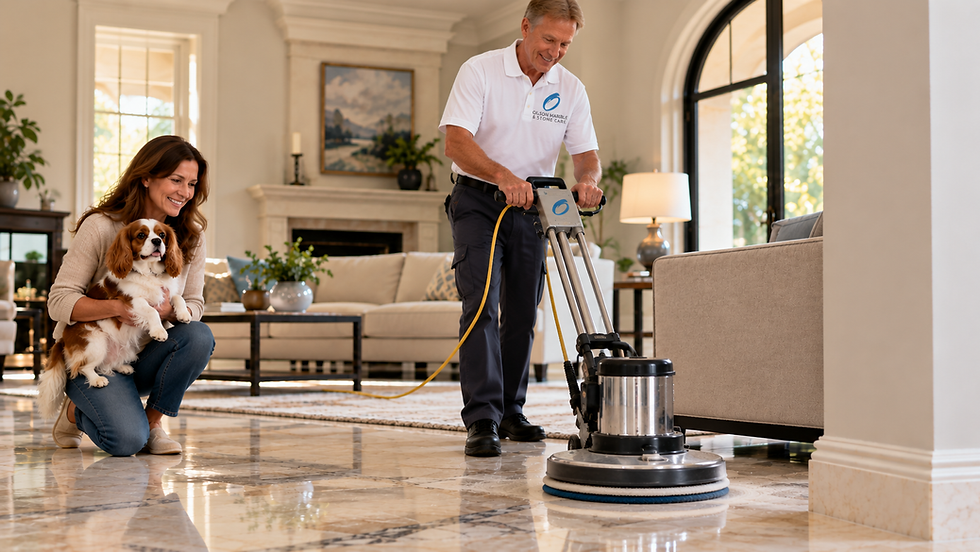
If you have a pet urine stain, dull spot, or persistent odor on natural stone, avoid experimenting with vinegar, acidic cleaners, or increasingly aggressive household products.
For homeowners and property managers in San Jose and throughout the Greater San Francisco Bay Area, Olson Marble & Stone Care can evaluate the affected surface and determine whether cleaning, stain treatment, honing, polishing, repair, or another restoration approach makes sense.
A proper diagnosis can tell you whether you're looking at something that needs cleaning, something that needs restoration, or something more extensive.
Frequently Asked Questions
Can dog urine permanently stain marble?
Yes, urine can penetrate marble and leave organic discoloration, particularly when it remains on the surface long enough to be absorbed. Whether the stain can be completely removed depends on the stone, its condition, previous protection, and how deeply the contamination has penetrated.
Can cat urine damage travertine?
Yes. Travertine is a calcite-based natural stone, and a pet accident can result in staining, finish damage, or persistent odor. Grout, joints, fills, and other porous areas may also need to be evaluated.
Will sealing marble protect it from pet urine?
A conventional penetrating sealer can improve stain resistance, but it does not make marble stain-proof or automatically protect the surface against etching. Even properly sealed natural stone should have pet accidents cleaned promptly.
Can vinegar remove pet urine odor from marble?
Vinegar should not be used as a general pet-urine treatment on marble, travertine, or limestone. These stones contain calcium carbonate and can be dulled or etched by acidic cleaners such as vinegar.
Can professionally restored marble look normal again after urine damage?
In many cases, professional treatment can substantially improve or restore stone affected by treatable staining or surface etching. The achievable result depends on the stone, finish, severity and depth of the damage, so the surface should be evaluated before a specific result is promised.


