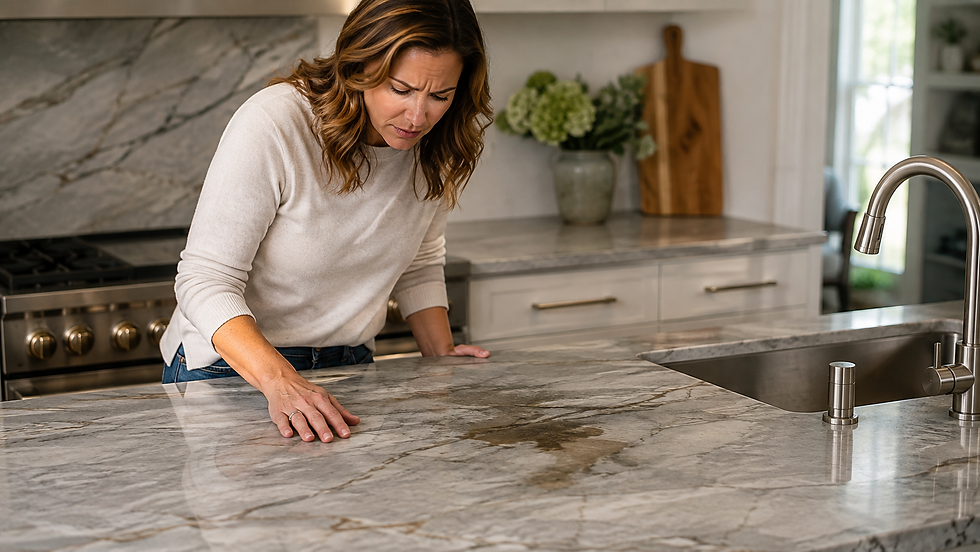
Can Quartzite Etch, or Was My Countertop Mislabeled?


Can quartzite etch? If a dull spot appears on a countertop sold as quartzite, the first question is whether the stone was mislabeled or whether the mark is something other than etching.
True, quartz-rich quartzite should resist ordinary kitchen acids. Marble and dolomitic marble can look similar but behave differently. Before assuming your countertop needs replacement, identify what changed. A dull finish, dark stain, and white mineral deposit are different problems.
For San Jose and Bay Area homeowners, the diagnosis determines whether the surface needs cleaning, stain treatment, honing, polishing, or another restoration process.
Can True Quartzite Actually Etch?
The U.S. Geological Survey defines quartzite as a metamorphic rock consisting mainly of quartz. Quartz is about 7 on the Mohs hardness scale, while calcite, a major mineral in marble, is about 3.
Quartz also behaves differently around acids. The Natural Stone Institute explains that siliceous stone is generally resistant to common kitchen acids, while calcium-carbonate stone is acid-sensitive. Strong industrial chemicals can still attack quartzite. For normal kitchen exposure, however, lemon juice or vinegar should not create the classic dull etch associated with marble.
Why Quartzite and Marble Can Look Similar but Behave Differently
Appearance alone is unreliable. White and gray quartzites can closely resemble marble.
The Natural Stone Institute's quartzite guidance explains why hardness and acid response are more useful than color, price, origin, or trade name. Quartzite can scratch glass. Marble and dolomitic marble are softer and react to normal acids.
A countertop sold as "soft quartzite" deserves scrutiny because the underlying material may be marble or dolomitic marble.
Quartzite Is Not the Same as Engineered Quartz
Quartzite is quarried natural stone. Engineered quartz is manufactured from quartz particles, resins, pigments, and other ingredients. The names are similar, but the surfaces are not interchangeable.
If you own a manufactured quartz surface rather than natural quartzite, the failure pattern and repair options can be different. Olson provides separate quartz and engineered stone services because proper surface identification should come before treatment.
Is the Mark an Etch, a Stain, or a Hard-Water Deposit?
Many homeowners use "etch" to describe any cloudy, dull, white, or dark area. A restoration professional separates those conditions by appearance, location, reflection, texture, and history.
A true etch changes the finish and often becomes obvious in reflected light. A stain changes color because material entered the stone. Mineral buildup remains on the surface and may look rough, crusty, or hazy.
What You See | Possible Problem | What Changed |
Dull area visible in reflected light | Etching or finish damage | Surface finish |
Darkened area | Staining or moisture absorption | Material below the surface |
White or crusty deposit | Mineral buildup | Material deposited on the surface |
Cloudy area near a sink | Hard water or cleaner residue | Surface contamination or finish |
Mark limited to one vein | Local mineral response | Local composition |
San Jose Hard Water Can Create a False Etching Alarm
San Jose Water reports groundwater hardness of 183 to 440 parts per million, or 11 to 26 grains per gallon. Water above 120 ppm is classified as hard. When hard water evaporates, calcium and magnesium minerals can leave white residue on surfaces.
That makes sinks, faucets, coffee stations, and frequently wet countertop areas important diagnostic locations in San Jose, Saratoga, Los Gatos, and nearby communities.
Do not automatically reach for vinegar because you suspect hard-water deposits. San Jose Water discusses vinegar for certain household items, but natural stone requires different judgment. Acidic products can damage calcareous stone, and the Natural Stone Institute's stone-care guidance specifically warns that lemon, vinegar, and other acids can dull or etch acid-sensitive surfaces.
Why Would a Countertop Sold as Quartzite Behave Like Marble?
If a mark is confirmed as genuine acid etching, material identification becomes critical. Quartzite is commonly confused with marble and dolomitic marble in the decorative stone trade because the slabs can look similar while having different chemistry.
Widespread etching from ordinary kitchen acids is a stronger warning sign than one isolated dull area. A commercial quartzite name may not match the stone's actual behavior.
The goal is not assigning blame. It is identifying the installed surface accurately enough to choose the right treatment.
One Reactive Vein Does Not Automatically Mean the Entire Slab Is Fake
Natural stone is not manufactured to a perfectly uniform formula. Quartz-rich material can include other minerals, and isolated veins or pockets may respond differently from the bulk of the slab.
A professional should therefore look at the pattern. Does the entire surface react? Is the problem limited to one vein? Is dullness concentrated where a cleaner was used? Is there a resin-treated area or previous repair?
The phrase "my quartzite etched" describes a symptom. It does not complete the diagnosis.
If evaluation shows the countertop is actually marble or another acid-sensitive material, AntiEtch marble protection may be worth discussing after the surface is restored. It is not a normal recommendation for genuine quartzite.
How Does a Stone Restoration Professional Confirm What Happened?
A good restoration evaluation starts before the machine comes out. The first job is to identify the failure.
A technician should examine where the mark occurs, whether reflected light changes across it, whether residue can be removed from the surface, whether moisture darkens the area, and whether certain veins behave differently. The cleaner or food involved matters. So does the original finish, especially when comparing polished, honed, and leathered surfaces.
Testing a spare sample or offcut is preferable to encouraging aggressive experiments on the center of an expensive island. A commercial name on an invoice is useful information, but it does not replace material behavior.
Why Sealing Does Not Make Acid-Sensitive Stone Etch-Proof
An impregnating sealer primarily reduces absorption. It can improve stain resistance, but it does not create an acid-proof film over the stone. The Natural Stone Institute describes these products more accurately as repellents rather than absolute seals.
This distinction causes frequent confusion. If liquid absorption is reduced but an acid-sensitive mineral is exposed at the surface, the sealer can be performing as intended while the stone still etches.
This is also why more sealer is not an automatic fix for dull spots. Olson's natural stone restoration services begin with identifying the stone, the finish, and the damage before choosing a correction.
Can the Damage Be Restored, or Does the Countertop Need Replacement?
Many finish-related problems can be evaluated for restoration before an otherwise sound countertop is removed.
Cleaning removes material sitting on the surface. Stain treatment addresses material absorbed below it. Etch restoration is different because the finish itself has changed. The affected area may need controlled honing or polishing to recreate a uniform finish.
With polished stone, the repaired area must match surrounding reflectivity. With honed stone, over-polishing can create a visible shiny patch.
Quartzite's hardness can require diamond abrasives and controlled grit progression. A technician should start with the least aggressive abrasive capable of removing the damage, establish uniformity, then move through finer steps needed for the target finish. The exact sequence depends on the stone, finish, depth, tooling, and response during testing.
Restoration or Replacement, Which Makes More Sense?
Replacement should not be the first conclusion because a countertop looks damaged. Consider the extent, stone type, overall condition, finish, whether damage is cosmetic or structural, and whether the cause will recur.
Large islands, waterfall edges, matched slabs, plumbing, and surrounding cabinetry can make replacement disruptive. A restoration evaluation can determine whether the existing installation has a viable path back to an acceptable finish.
Base the value decision on diagnosis, not a generic savings percentage.
Olson also handles other hard-surface needs through its concrete services, but quartzite countertop diagnosis belongs squarely within natural stone restoration.
When Should You Call Olson About a Quartzite Countertop?
Call a stone restoration professional when dull spots remain after neutral cleaning, the countertop appears to react to ordinary kitchen acids, the material identity is uncertain, or a polished area needs to be blended uniformly.
Diagnosis comes first. Acid cleaners can worsen a mineral-deposit problem if the underlying stone is acid-sensitive. More cleaning will not recreate a genuinely etched finish. Treating mislabeled marble as quartzite can also produce the wrong maintenance plan.
Olson Marble & Stone Care works with natural stone surfaces throughout San Jose and the Greater Bay Area, including high-value installations in Palo Alto, Saratoga, and Los Gatos.
What to Send Olson Before Your Evaluation
You can make the first conversation more productive with five pieces of information:
Take one photo of the entire countertop.
Take a close-up with light reflecting across the damaged area.
Photograph the mark in relation to the sink, faucet, coffee station, or cooktop.
Note what spilled or what cleaner was used before the mark appeared.
Find the slab name, invoice, or leftover sample if you still have it.
If your quartzite has unexplained dull spots, discoloration, or apparent etching, contact Olson Marble & Stone Care before assuming the slab needs replacement. A correct diagnosis should come before polishing, sealing, or any aggressive cleaning treatment.
Quartzite Etching FAQs
Does quartzite etch like marble?
No. Geologically true, quartz-rich quartzite should resist ordinary kitchen acids much better than marble. Marble contains acid-sensitive carbonate minerals that can lose their finish after contact with lemon juice, vinegar, or similar acids. If a surface sold as quartzite etches broadly, its material identity deserves closer evaluation.
Can lemon juice or vinegar etch real quartzite?
Normal kitchen acids should not etch genuine quartzite. They can etch marble and dolomitic marble, which are sometimes sold under confusing commercial quartzite labels. Strong industrial chemicals are different. Do not test an installed countertop aggressively when a spare sample or professional evaluation is available.
How can I tell if my quartzite countertop is real?
Do not rely on appearance alone. Quartzite and marble can look similar. Material identification can include hardness, response to ordinary acids on a safe sample, the pattern of existing damage, finish inspection, and any slab documentation. Testing an offcut is safer than experimenting on a finished kitchen surface.
Does sealing prevent quartzite from etching?
No. Penetrating or impregnating sealers are mainly designed to reduce liquid absorption and improve stain resistance. They do not make acid-sensitive minerals chemically resistant. A sealed stone can therefore resist staining better while still developing etching if the surface contains marble, calcite, dolomite, or another acid-sensitive mineral.
Can an etched quartzite countertop be restored?
Often, finish damage can be evaluated for professional restoration before replacement is considered. The method depends on the real material, finish, depth, and extent of damage. Genuine etching may require controlled honing and polishing, while stains, mineral deposits, and cleaning residue require different treatments. Diagnosis comes first.
Identify the Surface Before You Replace It

A quartzite countertop should not be judged from one dull mark. First determine whether you are seeing etching, staining, mineral buildup, cleaner residue, or another finish problem. Then determine whether the stone behaves like genuine quartzite or an acid-sensitive material sold under a quartzite trade name.
That sequence protects the countertop and your money. It also prevents a common mistake, treating the wrong problem with the wrong product. A mineral deposit does not need the same process as a stain. A stain does not need the same process as an etch. A genuine etch will not disappear because another cleaner was applied.
If you are dealing with unexplained etching or dullness in San Jose or the Greater Bay Area,
Olson can evaluate the surface, identify the likely failure, and determine whether professional restoration is appropriate. This is especially important when the countertop is part of a large island, matched slab installation, or other high-value kitchen where unnecessary replacement would create major disruption.
The right first step is not more cleaner, more sealer, or immediate replacement. It is an accurate diagnosis followed by the least aggressive corrective process capable of restoring the surface.