
Why Is My Quartzite Countertop Staining Even Though It Was Sealed?

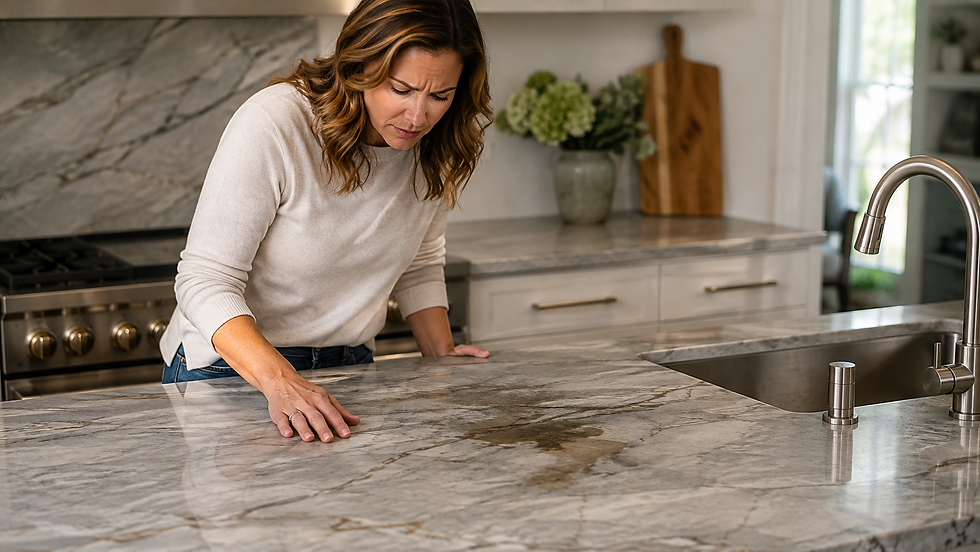
Quartzite countertop staining can happen even after the stone has been sealed. A penetrating sealer slows liquid absorption, but it does not make quartzite waterproof or stain proof. Dark areas can also come from absorbed moisture, oil, hard-water residue, silicone contamination, fabrication moisture, or a stone sold as quartzite that behaves differently than true quartzite.
The first step is not more sealer. It is identifying what the discoloration is, where it started, and how moisture or contamination is getting into or onto the stone.
Quartzite is also different from engineered quartz. If your surface is man-made quartz, Olson provides separate engineered quartz restoration services because the materials fail and respond to treatment differently.
Yes, Sealed Quartzite Can Still Stain
A penetrating sealer works below the surface. It enters the pore structure and reduces the rate at which water and oils can be absorbed. It does not form a thick waterproof film over the countertop.
That distinction matters. A good sealer gives you more reaction time after a spill. It cannot compensate for porous cut edges, seams, sink openings, or repeated standing water.
What a Penetrating Sealer Can and Cannot Do
Some quartzites are dense enough to need little sealer. Others absorb moisture more readily. The Natural Stone Institute-backed Use Natural Stone quartzite care guidance explains that sealing requirements vary with density and porosity.
A water mark after sealing can mean repellency has declined. It can also mean the stone was not completely dry when sealed, a worked edge was not adequately protected, or water is entering from another location.
More sealer does not remove oil already inside the stone. It does not dissolve hard-water deposits. It should not be applied over persistent internal moisture.
This is where professional natural stone restoration differs from routine maintenance. Diagnosis comes before selecting a cleaner, poultice, refinishing process, or sealer.
Why One Quartzite Can Behave Differently From Another
Quartzite forms when sandstone is transformed by heat and pressure. Variations in the stone affect porosity and moisture movement.
Trade names complicate the issue. Some materials marketed as "soft quartzite" are marble or dolomitic marble. True quartzite is highly resistant to common kitchen acids. If lemon juice produces a dull etched area, material identification may be part of the problem.
First Determine Whether the Mark Is a Stain
Dark, cloudy, dull, and greasy areas are not automatically the same problem. Treatment changes with the cause.
Oil must be removed from within the stone. Mineral deposits are treated at the surface. Moisture must be allowed to escape. Etching requires finish correction rather than stain removal. Sealer residue has its own treatment path.
Stain, Moisture, Mineral Deposit, or Etching?
What you see | Possible cause | Will more sealer fix it? |
Temporary dark area after water exposure | Moisture absorption | Possibly, after drying and evaluation |
Dark greasy area near a cooktop | Oil penetration | No |
Dark edge around a sink | Moisture entering through a cut edge, seam, or opening | Not until the source is corrected |
White or cloudy residue | Hard-water mineral buildup | No |
Dull area after acidic food or cleaner | Etching or questionable material identification | No |
Dark edge after installation | Fabrication moisture or resin-related issue | Requires diagnosis |
The Natural Stone Institute stain-removal guidance makes stain identification the starting point. Deep oil or organic stains may require a chemically matched poultice and repeated treatment. A poultice is not a generic cleaner. Its chemistry must match the contaminant.
If your stone reacts like marble rather than true quartzite, the service path changes. Olson's AntiEtch marble protection service is intended for acid-sensitive stone surfaces. It is not a fix for moisture inside true quartzite.
San Jose Hard Water Can Look Like a Stone Problem
San Jose Water reports hardness from 183 to 440 ppm as CaCO3 for groundwater and considers water above 120 ppm hard. Its hard-water guidance explains that calcium and magnesium can leave scale and residue on wet surfaces.
Around a quartzite sink, mineral deposits often look white, cloudy, chalky, or crusted. That differs from darkening caused by absorbed moisture.
This matters in San Jose, Los Gatos, Saratoga, and nearby Bay Area homes where sink splash and mineral-rich droplets can create several conditions in the same area.
White residue points toward surface deposits. Darkening points more toward absorption or contamination. Neither should be diagnosed from color alone.
Why Sink Edges, Seams, and Cutouts Are Common Trouble Spots
The polished face may not be where water is entering.
Countertops are fabricated with wet cutting and grinding. Sink openings, faucet holes, seams, and edge profiles expose newly worked stone. Those surfaces can absorb differently from the polished face.
A countertop can repel water in the middle of the slab and still darken around the sink because moisture is entering at an edge.
Water Can Enter Through a Worked Edge
Repeated splash exposure can keep a sink cutout wet. Water may move into an inadequately protected edge or enter near a seam. A plumbing leak below the counter can introduce moisture from the underside.
Capillary movement can make the visible dark area extend beyond the original entry point. Treating only the visible border may therefore fail.
A professional inspection should consider the surface, worked edges, underside when accessible, seams, faucet openings, caulk joints, and nearby plumbing. A water-drop test cannot show whether moisture is entering from a sink cutout or is already inside the slab.
Fabrication Moisture Can Show Up Later
Quartzite can be moisture sensitive during fabrication. Wet saws and polishing equipment introduce water into freshly cut stone. Some slabs also receive resin treatments during processing.
A 2026 Stone World report on industry training stressed drying quartzite before sealing and using a moisture meter when appropriate. The quartzite sealing guidance also described moisture becoming visible long after fabrication in problem installations.
That means a countertop can be sealed on the surface and still show delayed darkening if internal moisture was present beforehand.
Installation timing, the location of the dark area, moisture readings, and previous treatments help separate this condition from an ordinary food or oil stain. Repeated cleaning or resealing may never address the source.
What Should You Do Before Applying More Sealer?
Do not treat an unexplained dark area by stacking products over it.
Reduce water exposure and watch the pattern. Blot spills. Keep an affected sink edge dry when practical. Photograph the area under consistent lighting so you can see whether the discoloration shrinks, moves, or remains unchanged.
If darkening fades as the area dries, moisture absorption becomes more likely. A persistent greasy patch suggests oil. A chalky or crusted surface points more toward mineral buildup.
When Resealing Helps and When It Does Not
Resealing may help when the stone is dry, contamination has been removed, active leaks are ruled out, and the existing sealer is no longer providing adequate repellency.
Resealing will not remove absorbed oil, repair an active moisture path, remove mineral scale, correct etching, or solve silicone contamination. It should not be used to trap persistent moisture.
For a true stain, restoration may include targeted cleaning followed by a chemically matched poultice. The area then needs time to dry before the result can be judged. Some stains require more than one extraction cycle.
For finish damage, the process is different. Honing uses abrasives to remove a controlled amount of damaged surface and establish an even finish. Polishing refines that surface to a higher level of reflection. Neither process is a substitute for stain extraction.
Restoration, Fabricator, Plumber, or Replacement?
A restoration professional is appropriate for stain extraction, mineral deposits, sealer evaluation, finish correction, polishing, and many surface conditions.
A fabricator may need to address seams, edge treatment, installation, or fabrication-related conditions. A plumber belongs in the process when active water is entering from a faucet, supply line, drain, or sink assembly.
Replacement should be considered after the cause and realistic repair options are understood.
Olson Marble & Stone Care approaches these problems from the surface-failure side.
Olson also provides concrete restoration services for other hard surfaces, but concrete repair and coating chemistry are separate from quartzite diagnosis.
When Should You Call a Quartzite Restoration Professional?

Professional diagnosis makes sense when darkening keeps returning, the stone remains dark after drying, the problem follows a sink edge or seam, an oil stain has penetrated deeply, previous poultice attempts have failed, or cleaning has changed the sheen.
It is also appropriate when you cannot tell whether the condition is moisture, mineral scale, staining, etching, silicone contamination, or sealer residue.
What a Professional Evaluation Should Determine
A proper inspection should establish the stone type, location of the condition, likely contaminant, moisture source, depth of penetration, finish condition, previous treatments, and whether restoration is realistic.
That matters in high-end homes across San Jose, Cupertino, Palo Alto, Los Gatos, Saratoga, and the Greater Bay Area. Premium stone deserves a measured treatment plan rather than trial-and-error chemistry.
Quartzite countertops can represent a significant investment. Replacing a slab because of one discolored zone may be an expensive response to a treatable problem. Restoration can include stain extraction, mineral removal, moisture evaluation, refinishing, polishing, and resealing after the underlying issue is corrected.
There are limits. Deep contamination may not come out completely. Active plumbing or installation defects must be corrected at the source.
If your quartzite is staining or turning dark even though it was sealed, contact Olson Marble & Stone Care before applying another product. Identify the cause first, then decide whether the right next step is drying, stain extraction, restoration, resealing, fabrication correction, plumbing repair, or replacement.
Frequently Asked Questions
Can quartzite stain even after it has been sealed?
Yes. A penetrating sealer reduces liquid absorption but does not make quartzite waterproof or stain proof. Performance varies with the stone's porosity, sealer selection, application, edge treatment, exposure, and the substance involved. A sealed countertop can still absorb water or oil under the wrong conditions.
Why is my quartzite dark around the sink?
Darkening around a sink often points to moisture absorption. Water may enter through the polished surface, sink cutout, seam, faucet opening, or another worked edge. Repeated splash exposure and plumbing moisture can contribute. Let the stone dry and evaluate the entry point before adding more sealer.
Is a dark spot on quartzite always a stain?
No. A dark area may be absorbed moisture rather than permanent contamination. Oil can also darken stone, while hard-water minerals tend to leave white or cloudy residue. Etching causes dullness rather than a traditional stain. Correct identification matters because each condition requires a different treatment.
How do you remove stains from quartzite countertops?
Stain removal depends on what entered the stone. Surface residue may respond to professional cleaning, while deeper oil or organic contamination may require a chemically matched poultice and repeated extraction. The stone must dry between treatments so the result can be evaluated. Some deep stains cannot be removed completely.
Should I replace stained quartzite or have it restored?
Have it professionally evaluated before replacement. Localized staining, mineral deposits, finish damage, and some moisture-related conditions may be restorable. Plumbing defects, fabrication problems, or severe permanent contamination may require another trade or replacement. Diagnosis helps prevent spending thousands on a solution the countertop did not need.
The Right Fix Starts With the Right Diagnosis
A sealed quartzite countertop can still stain, darken, or develop mineral deposits. The important question is not whether another coat of sealer can be applied. It is whether sealer is relevant to the problem in front of you.
Moisture, oil, hard water, silicone, fabrication conditions, worked edges, material identification, and previous treatments can all change the restoration plan.
Do not cover an unexplained condition and hope it disappears. Have the stone evaluated before committing to more chemicals or replacement. If you are dealing with recurring quartzite discoloration in San Jose or the Greater Bay Area, Olson can determine what is happening, explain what can be restored, and give you a clear path forward.


